







There’s a tipping point when the majority of fantasy baseball managers agree during the season that a player must be picked up from the wire in all leagues. It happens when said player has performed at an acceptable level for a significant period. I use the term “significant period” because it’s both ambiguous and obtuse.
Sadly, the player’s performance isn’t the only thing dictating when the critical mass of managers finally decides to pick up a player. It can be slowed—but usually not accelerated—by meaningless factors. An unusual name can be enough to make managers balk. Take Scooter Gennett as an example. Despite being one of the best-hitting second basemen in 2017, Gennett had a 2018 ADP of 221 the following year. Some just thought it was a fluke that a guy named Scooter hit 27 home runs in a season. If your name is Matt Chapman, however, and you do the same thing, the next year your ADP is 100.
Another factor is reliever status. In most leagues, there’s a bias against non-closing relievers—a topic that I have railed against multiple times this offseason. That is why despite being incredibly valuable, Dellin Betances isn’t drafted before pick No. 200 in most leagues, even when healthy. Similarly, when a pitcher is supposed to be a starter but does not make the rotation, there’s a corresponding drop in his perceived value—so much so that we forget about how talented that pitcher is, and he’s universally left on the wire just waiting for some lucky guy to pick up. This happened with Josh Hader in 2018, and it’s happening to Josh James now.
Let me be clear: If you don’t pick up James now, you might not get to him. James is owned in just 23% of Yahoo leagues and 12% of ESPN leagues. Fantasy managers now know how valuable Hader was in 2018. Even as a non-closer, Hader has an ADP that hovers around 100. James may not be as good as Hader—since nobody really is—but he has the potential to be close for at least a few months. He demonstrated as much Sunday. At Tropicana Field, James carved up the Rays to the tune of four strikeouts in two no-hit innings, using only 23 pitches.
What made James’ performance impressive wasn’t his velocity, despite its elite status. It was his control—something he has been criticized for in the past. James lived on the edges of the strike zone, using all his pitches, and had a clear, effective plan of attack against both lefties and righties. Take a look at James’ pitch chart below. Fastballs are in red, sliders are in blue, and changeups are in green. Each circle is where a pitch crossed the plate. Each is accompanied by two numbers: the one inside the circle is the number in his pitch sequence, and the number outside, down, and to the right is that pitch’s velocity.
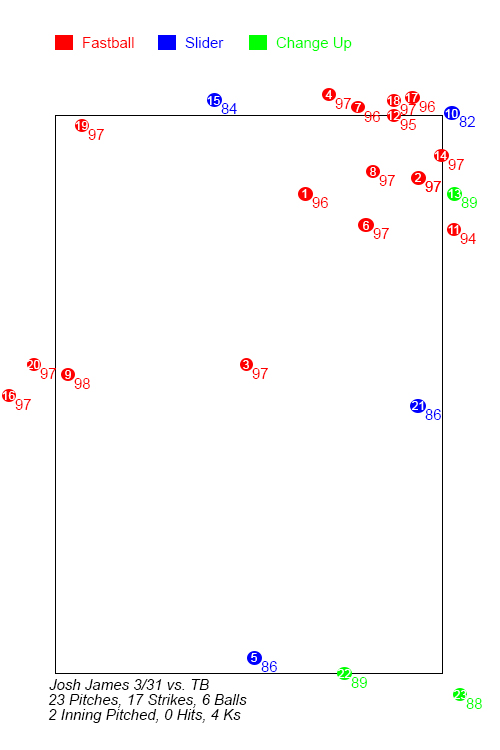
You’ll notice that James left just one pitch in the middle of the plate (No. 3), which was fouled off. He faced five consecutive right-handed batters, which counted for pitch Nos. 1-20. Each of those pitches was located either on the black, just off the plate, or up-and-in. It takes real control to be able to hammer the strike zone that close to the hitter without either plunking the batter or leaving a pitch a little too much over the plate.
The fastball was dominant, averaging 96.6 mph and accounting for 16 of his 23 pitches. James was able to pound away up-and-in while throwing just enough on the outside corner to keep hitters off balance. The result was a whiff rate of 60%. His fastball also accounted for three out of his four strikeouts. James manhandled Willy Adames, Yandy Diaz, Tommy Pham, Daniel Robertson and Avisail Garcia—all righties—with the hard stuff. When lefty Austin Meadows came up, James gave him three straight offspeed pitches away for the easiest of his K’s.
Overall, James had a whiff rate of 52% on the night and only seemed to be getting stronger as he got more comfortable. I wrote in my 10 semi-bold dynasty predictions that James will become the next Hader, and James’ easy Sunday outing only furthers this belief. He has the talent and is in the role to give you four to five innings per week of elite ERA/WHIP/K while putting out fires for the Astros. And if he’s too good at this role and gets promoted to be a starter, what do you have to lose?
You might be thinking it’s too early to make this move—and if you are, I’m guessing you missed out on Hader a year ago as well. Trust me: You do not want to be late to this party. Pick him up now and thank me later.
(Photo by Leslie Plaza Johnson/Icon Sportswire)
